Navigation behavior
Lidar, gyroscope and hybrid navigation paths are checked against obstacle recovery, room coverage, docking repeatability and low-light behavior.
INNOVATION LEADER LAB
The Irobot engineering lab turns buyer requirements into validated connected-appliance platforms. Teams use it to compare navigation options, tune motor behavior, review firmware risk, verify app flows and prepare compliance evidence before committing to tooling.
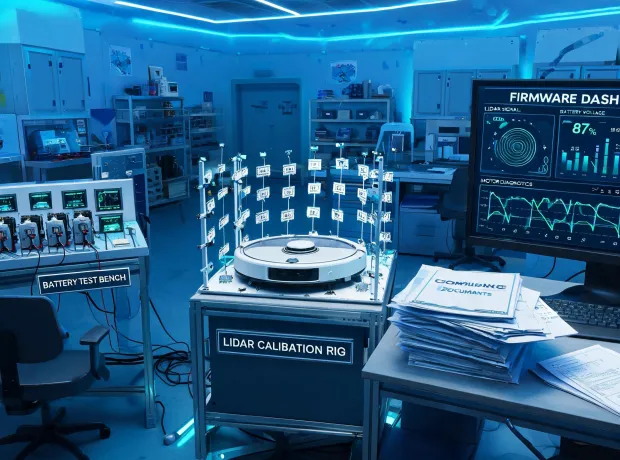
Lidar, gyroscope and hybrid navigation paths are checked against obstacle recovery, room coverage, docking repeatability and low-light behavior.
Brush design, suction curve, dust path, mop water flow and filter pressure drop are reviewed together so performance claims remain realistic.
Pairing, OTA recovery, diagnostic logs, privacy language, app alerts and smart-home gateway requirements are tested before pilot handoff.
Runtime, noise, dock charging, wheel endurance, tank sealing and accessory replacement plans are documented for sourcing and warranty teams.
The lab exists because robotic cleaning appliances are multi-disciplinary products. Mechanical cleaning performance, sensing, power management, firmware and compliance all affect the buyer experience. A change in one area can create cost, warranty or launch problems elsewhere. By reviewing the program in a controlled lab sequence, Irobot gives sourcing teams a clearer view of which features are worth the cost and which risks need mitigation before the product is shown to retailers or platform partners.
A lab review usually begins with the buyer's retail promise: cleaning area, noise target, map quality, pet-hair pickup, mop control, dock convenience, app language, accessory price and expected return tolerance. Engineers then translate that promise into measurable checkpoints. The process is deliberately practical. It does not attempt to prove every possible feature; it focuses on the claims that will appear on packaging, marketplace pages, buyer presentations and service scripts. This keeps pilot testing focused and gives commercial teams language they can safely use.
When the project includes software or smart-home integration, the lab also reviews pairing behavior, OTA fallback, diagnostic events and privacy-facing text. These details matter because a connected appliance can fail in ways that a traditional appliance cannot: a user may lose Wi-Fi, a phone app may change permission behavior, or a firmware update may expose a weak recovery path. Irobot records those risks before mass production so buyers can decide which features belong in the first release and which should wait for a later roadmap.
Share the feature target, price band and channel risk. We will recommend the tests that should happen before your pilot order.